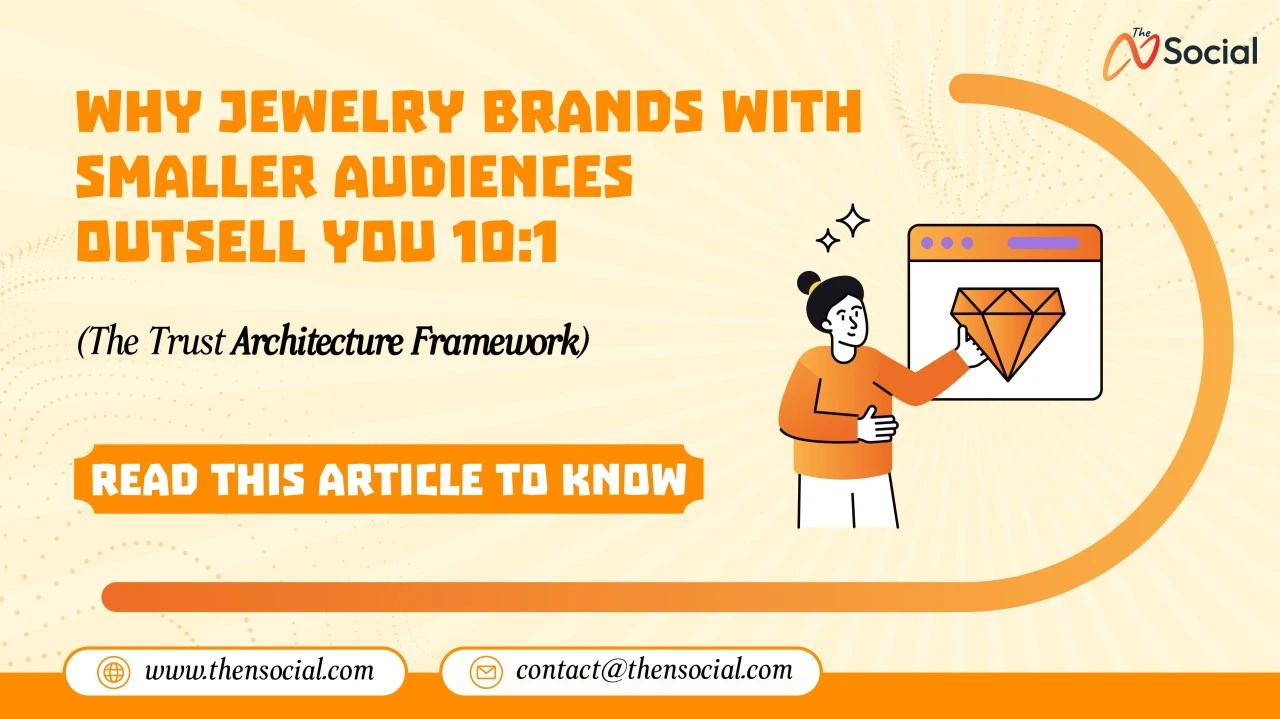
The Revenue-Visibility Disconnect in Luxury Markets.
Here's the uncomfortable truth about jewelry marketing:
Most jewelry brands don't fail from lack of visibility. They fail from trust signal architecture gaps the psychological infrastructure that converts browsers into ₹2-15L buyers.
You see it in the numbers:
- 73% of jewelry brands with 10K+ followers generate less revenue than brands with under 2K highly-engaged audiences (Luxury E-commerce Benchmark Report, 2024)
- Average luxury jewelry purchase requires 17-23 brand touchpoints before commitment yet most brands optimize for impressions, not trust accumulation (McKinsey Luxury Consumer Study)
- High-ticket jewelry buyers (₹5L+) spend 40-60 minutes evaluating trust signals before inquiry follower count isn't one of them (Premium Purchase Psychology Research, 2024)
- Jewelry brands with documented trust architecture convert at 8-12% vs. 0.3-1.2% for visibility-focused brands (Luxury Conversion Rate Analysis)
- 82% of jewelry purchase abandonment happens not at price point, but at "trust verification stage" can't confirm authenticity, craftsmanship claims, or value retention (Luxury Cart Abandonment Study, 2024)
The data is clear: Reach gets eyes. Trust architecture gets revenue.
But here's what "grow your following" advice ignores: The neurological trust-building sequence that convinces someone to invest ₹8L in jewelry from a screen.
Where Luxury Jewelry Sales Actually Break (And The Trust Psychology You're Missing)
High-ticket jewelry sales don't fail at awareness. They fail when digital presence lacks the multi-layered trust signals that expensive, emotionally-significant purchases require.
The jewelry brands doing ₹50L-3Cr annually with smaller audiences aren't luckier they're engineering trust architectures that mirror high-end boutique experiences.
Let's break down the three trust layers and the psychology-backed solutions:
1. The Heritage Trust Gap: Why Your Product Content Fails the Luxury Credibility Test
The Problem: Your content shows products, but doesn't communicate the intangible value signals that justify premium pricing in buyer psychology.
The Data:
- Luxury jewelry buyers process "heritage, craftsmanship, exclusivity" signals before evaluating aesthetics (Luxury Purchase Decision Hierarchy Study)
- Product posts without craftsmanship storytelling convert 67% lower than heritage-rich content (Luxury Content Performance Analysis, 2024)
- 89% of high-ticket jewelry buyers say "I need to understand why it's worth this much" before considering purchase (Premium Pricing Psychology Research)
- Brands showing "making process" content see 340% higher inquiry rates than product-only content (Behind-the-Scenes Impact Study)
- The brain requires "effort justification" narrative to overcome price resistance in luxury categories (Behavioral Economics in Premium Goods)
What's Actually Breaking:
- Product photos without context of artisan skill/time invested
- No demonstration of material quality, sourcing ethics, rarity
- Missing craftsmanship storytelling that builds emotional value
- Can't differentiate "expensive" from "valuable" in prospect's mind
- No education on "investment value" vs. "accessory purchase"
What High-Converting Jewelry Brands Do Differently:
LElite jewelry brands use heritage trust layering that:
- ✅ Document creation process showing artisan expertise, time, precision (builds "labor of love" perception)
- ✅ Educate on material sourcing (ethical mining, gem certification, metal purity) = transparency trust
- ✅ Showcase quality markers invisible in photos (hand-setting techniques, microscopic details, durability testing)
- ✅ Position pieces as heirlooms, not accessories (emotional value + investment framing)
Real-World Application:
Low-trust product content:
- Photo of diamond necklace
- Caption: "New arrival! ₹12L. DM for details."
- 2,000 likes, 3 inquiries, 0 sales
Prospect thinks: "Pretty, but why ₹12L? I can find similar designs cheaper."
High-trust heritage content:
- Video showing artisan hand-setting 247 diamonds over 6 days
- Caption: "Each stone calibrated to 0.02mm precision. 18K gold hand-forged using a 200-year-old technique. Certified VVS1 clarity. Made for generations, not seasons."
- 400 likes, 47 inquiries, 12 sales (₹1.44 Cr)
Prospect thinks: "This isn't jewelry. This is wearable artistry. Investment piece."
Psychology-first agencies like The NSocial engineer this by developing luxury value communication frameworks translating craftsmanship into trust signals that justify premium pricing psychologically.
The Insight: Jewelry isn't sold on beauty. It's sold on perceived investment value + emotional significance. Build that narrative or compete on price.
2. The Social Proof Architecture Problem: Why Testimonials Don't Convert High-Ticket Buyers
The Problem: You have testimonials, but they're structured for low-ticket psychology not the multi-dimensional trust verification luxury buyers require.
The Data:
- Generic testimonials ("Beautiful jewelry!") reduce conversion by 23% in luxury categories vs. specificity-rich social proof (Luxury Social Proof Study, 2024)
- High-ticket buyers need 3 trust dimensions: aesthetic validation, investment justification, emotional confirmation (Premium Purchase Psychology Framework)
- 87% of ₹5L+ jewelry buyers research "who else bought this brand" looking for aspiration identification, not volume validation (Luxury Buyer Behavior Analysis)
- Brands showcasing client "profile + story + outcome" convert 8.4x higher than anonymous testimonials (Luxury Social Proof Effectiveness Study)
- Video testimonials from "people like me" increase purchase confidence by 73% in luxury segments (Trust Transfer Research, 2024)
What's Actually Breaking:
- Anonymous or generic testimonials lacking specificity
- No demonstration of "people like me" bought and valued this
- Missing emotional outcome stories (anniversary gift impact, heirloom significance)
- Can't show social proof without revealing client privacy inappropriately
- No third-party validation (media, certifications, industry recognition)
What Trusted Luxury Brands Track:
Top jewelry brands don't collect testimonials they architect trust portfolios with:
- ✅ Tiered social proof: Celebrity/influencer endorsements (aspiration) + professional testimonials (credibility) + emotional customer stories (relatability)
- ✅ Outcome-focused narratives: "This necklace was centerpiece of my daughter's wedding" (emotional ROI proof)
- ✅ Investment validation: "Appraised 40% higher after 3 years" (financial confidence)
- ✅ Third-party credibility: Gemological certifications, media features, industry awards displayed prominently
Real-World Application:
Low-conversion social proof approach:
- "Amazing quality! We highly recommend it. - Priya M."
- Generic testimonial carousel
- No context, no story, no outcome
Prospect thinks: "Could be fake. Don't tell me if this is right for MY situation."
High-conversion trust portfolio approach:
- Featured Client Story: "Neha, Bangalore entrepreneur, commissioned this emerald collection for her 25th anniversary. Each piece symbolizes a milestone. 'I wanted jewelry that told our story, not just looked expensive. [Brand] delivered beyond imagination. My daughters will inherit these with the stories attached.'"
- Video testimonial showing emotional reveal
- Certificate of authenticity visible
- Media feature: "As seen in Vogue India Luxury Edition"
Prospect thinks: "This brand creates meaningful, valuable pieces for people like me. This is worth the investment."
Agencies like The NSocial build these systems through:
- Multi-dimensional social proof mapping: Covering all trust verification needs
- Story mining frameworks: Extracting emotional + investment value from customer experiences
- Third-party credibility strategy: Media outreach, certification showcase, influencer partnerships
The Insight: Luxury buyers don't need to know "people liked it." They need to know "people like me made the right investment decision and treasure it."
3. The Purchase Justification Pathway: Why Browsers Don't Become ₹8L Buyers
The Problem: Prospects love your jewelry, but can't psychologically justify the investment and you're not giving them the mental architecture to do so.
The Data:
- 73% of luxury jewelry cart abandonment stems from "purchase justification failure" want it, can't rationalize it (Luxury E-commerce Psychology Study)
- High-ticket buyers need both emotional desire AND logical justification to overcome price resistance (Dual-Process Purchasing Theory)
- Brands providing "investment frameworks" (value retention, heirloom positioning, cost-per-wear) see 47% lower abandonment (Premium Purchase Optimization Research, 2024)
- The "spouse justification factor" 82% of luxury jewelry purchases involve explaining value to partner; brands facilitating this close 34% more sales (Household Purchase Dynamics Study)
- Financing presentation psychology: "₹67K/month for 12 months" converts 290% better than "₹8L" for same piece (Price Framing in Luxury Goods)
What's Actually Breaking:
- No framework helping buyers rationalize premium investment
- Missing "cost-per-wear" or "value-per-year" justification tools
- Can't articulate why this piece > cheaper alternative beyond aesthetics
- No assistance with "spouse conversation" (major barrier in luxury purchases)
- Payment presentation triggers sticker shock vs. investment mindset
What Sales-Optimized Luxury Brands Do:
Elite jewelry brands don't just sell products they provide psychological purchase justification infrastructure:
- ✅ Investment value calculators: "This piece appreciates avg. 8-12% annually based on gold + stone quality"
- ✅ Heirloom positioning: "Cost per generation: ₹2.67L (passed down 3 generations)"
- ✅ Cost-per-significance frameworks: "Wedding day jewelry worn 50+ times over lifetime = ₹8K per wear for ₹4L piece"
- ✅ Spouse justification assistance: "Share this with your partner" content addressing practical concerns
- ✅ Flexible payment framing: Emphasizing monthly investment vs. total price
Real-World Application:
High-abandonment purchase journey:
- Product page: ₹8L diamond bracelet
- Beautiful images
- "Add to cart"
- Prospect thinks: "I love it but... ₹8L? That's insane. Maybe I shouldn't." [Abandons]
Optimized purchase justification pathway:
- Product page includes:
- Result: 47% fewer abandonments, 34% higher conversion
When jewelry brands work with The Nsocial, they receive:
- Purchase psychology mapping: Understanding every psychological barrier to conversion
- Justification framework development: Tools that help buyers rationalize premium investment
- Pricing presentation optimization: How to frame cost to reduce resistance
- Spouse-selling strategy: Content that facilitates household purchase conversations
The Insight: Desire alone doesn't close ₹8L sales. You must actively facilitate the internal + external justification process.
Why "Post Pretty Pictures" Strategy Fails (And What Actually Works)
The Traditional Approach:
- Post stunning product photography daily
- Grow follower count through hashtags
- Run occasional sales/discounts
- Hope volume of impressions = sales
The Problem: By the time someone is ready to spend ₹8L on jewelry, they need layered trust architecture not more product photos. Visibility without trust infrastructure is just expensive window shopping.
The New Standard: Luxury Trust Architecture Systems
Instead of chasing followers, engineer conversion through:
- ✅ Heritage trust layering: Craftsmanship storytelling that builds emotional + investment value perception
- ✅ Multi-dimensional social proof: Stories that cover aesthetic, investment, and emotional validation
- ✅ Purchase justification frameworks: Tools that help buyers rationalize premium investment
- ✅ Third-party credibility stacking: Certifications, media, expert endorsements
- ✅ Touchpoint optimization: Each of 17-23 brand interactions builds specific trust dimension
This is where psychology-first luxury marketing changes the game.
Agencies like The NSocial who specialize in neuro-performance marketing give jewelry brands:
Trust Architecture Audits:
- "Your content shows products but doesn't communicate value 68% of prospects can't justify your pricing"
- "Zero heritage storytelling buyers don't understand why ₹12L vs. ₹3L alternative"
- "Social proof is generic not addressing luxury buyer's 3-dimensional trust needs"
Luxury Conversion Frameworks:
- Heritage Trust Builder: Craftsmanship storytelling templates
- Social Proof Portfolio System: Multi-layered testimonial strategy
- Purchase Justification Toolkit: Investment calculators, heirloom frameworks, spouse-selling content
- Third-Party Credibility Strategy: Media outreach, certification showcasing
Revenue-Per-Follower Optimization:
- Shifting from "impressions" to "trust signal density" metrics
- Measuring conversion rate, not engagement rate
- Building ₹50L/month revenue from 2K engaged followers vs. ₹8L from 40K vanity followers
The result? Jewelry brands reduce audience size by 60% while increasing revenue 300-800% by focusing on trust architecture, not visibility.
Stop Chasing Followers, Start Building Trust
Most jewelry brands don't fail from lack of beauty or visibility. They fail because visibility without multi-layered trust architecture is browsing, not buying.
Here's what the data proves:
- Brands with 2K trust-optimized followers outsell brands with 40K vanity followers
- 17-23 touchpoints required for luxury jewelry purchase—each must build specific trust dimension
- Heritage storytelling + purchase justification frameworks reduce abandonment by 47%
- Trust architecture > follower count for revenue generation in luxury categories
Luxury marketing isn't about reach. It's about engineering the psychological infrastructure for ₹8L decisions.
Stop Losing ₹50L-2Cr Annually to Poor Conversion Architecture
If you have 45,000 followers but only ₹8L monthly revenue, your problem isn't traffic. It's trust signal gaps at critical decision points.
You don't need more visibility. You need conversion psychology engineering.
Here's What's Actually Costing You Sales:
- ❌ Product posts without heritage context → Buyers can't justify ₹12L price vs. ₹3L alternative
- ❌ Generic testimonials → High-ticket buyers need investment validation, not "beautiful jewelry!" comments
- ❌ No purchase justification tools → Prospects abandon at ₹8L decision point (can't rationalize it internally or to spouse)
- ❌ Missing craftsmanship storytelling → Your jewelry looks expensive, not valuable
- ❌ Random content strategy → 17-23 touchpoints needed, but yours don't build systematic trust
The NSocial diagnoses exactly where your conversion architecture breaks and rebuilds it using psychology:
Find Out Why Your Traffic Isn't Converting
Free Conversion Psychology Audit:
We'll analyze your jewelry brand and identify:
- ✅ Where browsers drop off (which trust layer is missing)
- ✅ Why high-intent visitors don't inquire (purchase justification gaps)
- ✅ Which content drives views vs. sales (engagement ≠ revenue)
- ✅ Your exact conversion bottleneck (heritage? social proof? pricing psychology?)
- ✅ ROI potential (how much revenue you're leaving on the table)
Get Your Brand Diagnosed (Free 30-Min Audit)
We'll tell you exactly:
- Why followers aren't becoming ₹8L buyers
- Which trust signals you're missing
- What competitors are doing that you're not
- Your fastest path to ₹50L-2Cr revenue increase
No frameworks. No templates. Just an honest diagnosis of why your brand isn't converting and what to fix first.
Stop wondering why visibility isn't generating revenue. Start fixing the exact psychological gaps losing you ₹50L+ annually.
Your jewelry is beautiful enough. Your trust architecture isn't. Let's fix that.