The Authority Gap on LinkedIn Why Two Experts With the Same Skills Have Completely Different Audiences.
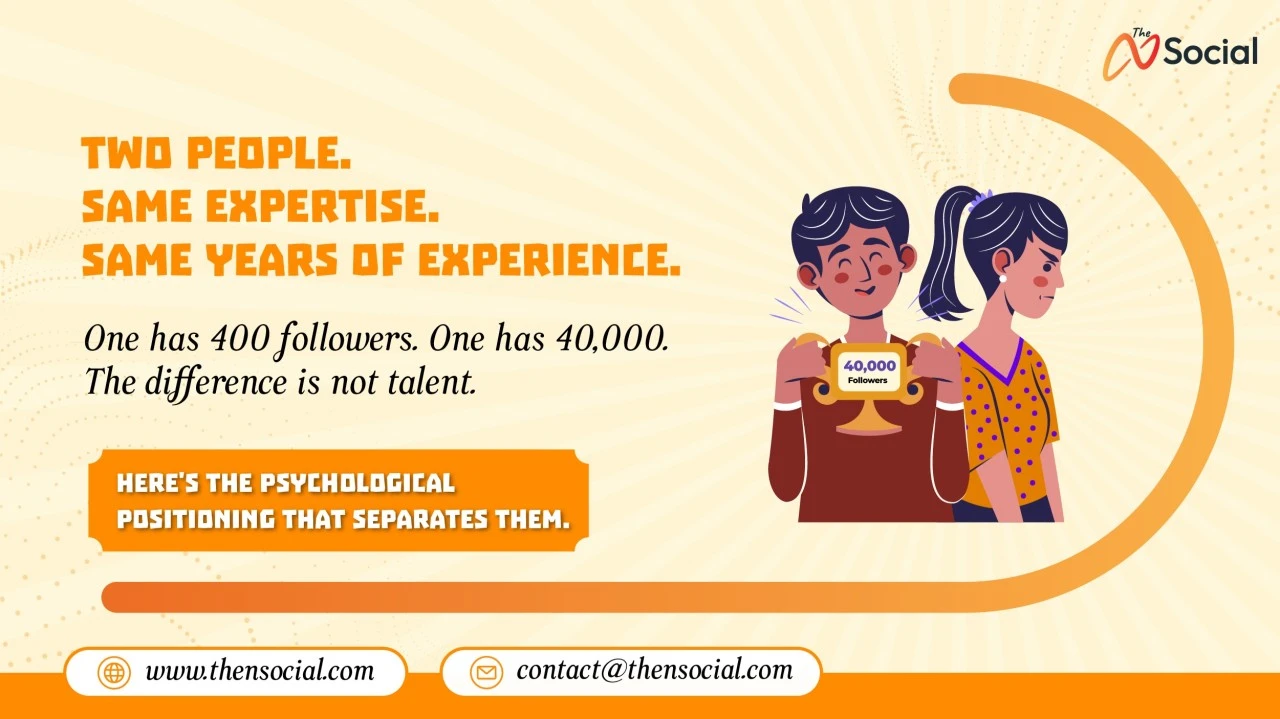
The Gap Is Not What You Think Every week, a highly skilled consultant watches someone less experienced explode on LinkedIn. Less time in the industry. Fewer credentials. Simpler work. But somehow more visibility, more inbound, and more authority. The reaction is almost always the same. "The algorithm must favour them." "They probably paid for followers." "LinkedIn rewards entertainment over expertise." None of that is true. What's actually happening is a psychology problem not a platform problem. And until you understand it, you'll keep producing great content that reaches nobody.
What the Brain Does When It Meets an Expert
When a stranger lands on your LinkedIn profile, their brain runs an instant background check Not on your credentials. Not on your experience. Not on your certifications. On your perceived status. Perceived status is not the same as actual status. It's the impression the brain forms in the first few seconds based entirely on signals it receives from your positioning, your language, your visual identity, and your content structure. Psychologist Robert Cialdini's research on influence confirms this directly. The brain uses mental shortcuts heuristics to assess authority before it evaluates substance. This means someone with weaker credentials but stronger positioning signals will consistently outrank a superior expert in the mind of the same audience. The 40,000-follower person isn't more talented. They just learnt to speak the language the brain uses to identify authority.
1. The Clarity Signal
The number one mistake experts make on LinkedIn is writing a headline that describes what they do instead of what they change. "Senior Marketing Consultant | 15 Years Experience" The brain files this under 'one of many'. Compare it to: "I help B2B founders stop losing qualified leads to brands half their size." Same expertise. Completely different signal. Specific outcomes trigger authority recognition. Generic titles trigger invisibility.
2. The Consistency Signal
The brain builds trust through repetition. Experts who own one clear topic and return to it relentlessly are perceived as the definitive voice on that topic. Experts who post about marketing on Monday, mindset on Wednesday, and travel on Friday are perceived as interesting but not authoritative. The brain does not trust generalists with specific problems. If your content doesn't have a clear throughline, your audience can't build a mental category for you and people don't follow what they can't categorise.
3. The Social Proof Signal
LinkedIn audiences don't evaluate social proof rationally. They evaluate it relationally. Who is engaging with this person? Who are they associated with? Whose names appear in their comments? One comment from a recognised name in your industry does more for your perceived authority than fifty generic "great post!" responses. This is why community building on LinkedIn is not a vanity exercise. It is a neurological credibility mechanism.
4. The Scarcity Signal
Experts who position themselves as accessible to everyone are unconsciously perceived as valuable to no one. The brain associates selectivity with quality. Think about the most respected names in your industry. They don't pitch everyone. They don't accept every project. They don't follow everyone back. That selectivity even when subtle fires a powerful authority signal. Scarcity is not arrogance. It's positioning.
5. The Conviction Signal
The most followed experts on LinkedIn share one trait that has nothing to do with follower count, posting frequency, or content format. They have a clearly stated point of view that a specific audience strongly agrees with and another audience mildly disagrees with. Neutrality is invisible on LinkedIn. The brain is not wired to follow people who agree with everyone. It follows people who articulate what it already believes but couldn't find the words for. The experts who struggle on LinkedIn are almost always trying to appeal to everyone. The experts winning on LinkedIn have decided who they're not for.
Why the Gap Gets Wider Over Time
Here's what makes the authority gap dangerous. It compounds. The expert with stronger positioning signals gets more visibility. More visibility generates more engagement. More engagement signals authority to the algorithm. The algorithm rewards them with more reach. More reach attracts better-known connections. Better-known connections amplify perceived status. And the gap between them and the equally skilled expert widens every single week. This is not a content volume problem. You cannot post your way out of a positioning problem. More content without corrected positioning just creates more of the wrong signal at higher frequency.
The Question That Fixes Everything
Before you write your next post, your next article, your next LinkedIn update answer this one question: When my ideal client reads this, do they feel like they've finally found the person who understands their exact problem or do they feel like they've found another expert in a crowded space? If the answer is the latter, your positioning is the problem. Not your content. Not your consistency. Not your credentials. Your signal.
The Space Is Still Open. For now.
LinkedIn authority is not infinite. Every industry has a finite number of dominant voices the platform and the brain will recognise. Once those positions are claimed, the cost of claiming them multiplies. The consultants and founders who move now who fix their positioning before a competitor claims their space will own that authority for years. The ones who wait will spend those same years wondering why the algorithm never works in their favour. The algorithm isn't the problem. The gap was always a positioning problem.
The Nsocial helps consultants, founders, and executives close the authority gap through psychological positioning built specifically for LinkedIn.