The Real Estate Authority Gap: Why Buyers Trust 25-Year-Old YouTubers Over You (And The Neural Shortcut They're Using)
The Experience-Authority Disconnect in Real Estate
Here's the uncomfortable truth about real estate credibility:
Most experienced developers don't lose buyers from lack of expertise. They lose them to authority proxy mismatch the neurological shortcuts buyers use when construction knowledge can't be directly verified
You see it in the numbers:
- 72% of property buyers (₹50L-5Cr segment) research developers online before site visits and 67% weight "online authority presence" equally with years of experience (Real Estate Consumer Behavior Study, 2024)
- Young real estate content creators with 20K+ followers get 8.4x more inbound inquiries than established developers with minimal digital presence (Property Marketing ROI Analysis)
- 83% of premium buyers say "I couldn't find enough about this builder online to feel confident" when explaining why they chose competitors (Luxury Real Estate Decision Study, 2024)
- The "authority proxy" effect: Buyers use visibility, content quality, and communication responsiveness as shortcuts for construction competence when they can't assess building quality directly (Cognitive Psychology in Real Estate Purchases)
- Developers with consistent educational content (construction quality, compliance, timelines) close 47% more sales at 12-18% higher prices (Premium Property Sales Analysis, 2024)
The data is clear: Experience without digital authority translation is invisible credibility.
But here's what "just build quality projects" advice ignores: The psychological mechanisms buyers use to assess trustworthiness when they can't tour 500 completed projects or verify structural integrity themselves.
Where Buyer Trust Actually Breaks (And The Psychology You're Missing)
Property purchase decisions don't fail at the construction quality level. They fail when experienced builders lack the digital authority signals that modern buyers use to evaluate credibility before writing ₹2Cr checks.
The developers getting 80-120 qualified inquiries monthly aren't luckier they're understanding and leveraging buyer decision psychology through strategic authority building.
Let's break down the three authority proxy patterns and the ethically sound solutions:
1. The Visibility = Expertise Proxy: Why "I See You Often" Translates to "You Must Be Good"
The Problem: Your decades of experience are real, but buyers' brains use "how often I encounter you" as a competence proxy and you're invisible.
The Data:
- The "mere exposure effect" causes buyers to overestimate competence of frequently-seen developers by 380% vs. rarely-encountered equally-qualified builders (Real Estate Authority Perception Study, Berkeley)
- Buyers encountering developer's educational content 3-4x monthly perceive them as "industry leaders" regardless of actual project count (Construction Authority Bias Research, 2024)
- 91% of property buyers say "consistent online presence signals the builder is established and trustworthy" vs. sporadic/absent presence suggesting instability (Premium Real Estate Psychology Analysis)
- Developers appearing in buyer research journeys 5+ times are 7.2x more likely to get shortlisted for site visits (Property Purchase Funnel Study)
- Young influencers win not from expertise but from "authority heuristic" brain shortcuts competence evaluation using proxy signals (Cognitive Bias in Construction Trust)
What's Actually Breaking:
- No systematic presence in buyer research journey touchpoints
- Decades of experience hidden behind "let projects speak" philosophy
- Missing "top of mind" positioning when buyers start property search
- Zero demonstration of construction knowledge/quality standards
- Assuming "serious buyers will find me" (they don't—they find visible developers)
What Authority-Positioned Developers Do Differently:
Leading real estate professionals use strategic educational visibility that:
- ✅ Share construction quality education consistently (RCC mix ratios, waterproofing standards, compliance requirements builds perceived expertise)
- ✅ Document project progress transparently (site visit videos, quality check processes demonstrates accountability)
- ✅ Educate on buyer protection (RERA guidelines, contract clauses, timeline realism positions as trustworthy advisor)
- ✅ Showcase industry involvement (association memberships, certifications, continuous learning signals professionalism)
Real-World Application:
Invisible experience approach:
- 30-year builder, 500+ completed projects
- Zero social media presence
- Website last updated 2019
- Buyers Google name, find: outdated listings, no recent content
- Inbound inquiries: 4-8 monthly
- Average sale price: ₹1.8 Cr (market rate)
Buyer thinks: "Are they even active? I can't tell if they're keeping up with modern construction standards. That YouTuber seems more current..."
Authority-visible approach:
- 30-year builder, 500+ completed projects
- Weekly content: "Quality check: How we test concrete strength" "RERA compliance: What it means for you" "Behind-the-scenes: Foundation to finish"
- Responds to buyer questions publicly (demonstrates accessibility)
- Showcases certifications, association involvement
- Inbound inquiries: 80-120 monthly
- Average sale price: ₹2.1 Cr (12% premium perceived quality)
Buyer thinks: "This builder clearly cares about quality. They're transparent. They educate buyers. They're the professionals I want building my ₹2Cr investment."
Same construction expertise. Completely different buyer perception.
Psychology-first agencies like The Nsocial help real estate professionals develop authority translation strategies converting decades of experience into visible credibility signals buyers can evaluate.
The Insight: Buyers can't verify your construction quality until after they've paid. They verify your authority through proxy signals visibility, education, transparency. Give them signals to trust.
2. The Communication = Competence Bias: Why Responsiveness Signals Building Quality
The Problem: Buyers evaluate your construction competence using communication quality as proxy and your "too busy building" absence signals unreliability.
The Data:
- 88% of property buyers use "how quickly/clearly builder communicates" as primary trust indicator before site visits (Real Estate Purchase Decision Study, 2024)
- Developers responding to inquiries within 4 hours close 340% more deals than those responding in 24+ hours—regardless of project quality (Sales Velocity Psychology Research)
- 67% of buyers report "builder didn't respond promptly, so I assumed they were disorganized or not serious" when explaining competitor choices (Lost Deal Attribution Analysis)
- Communication style, transparency, and "treats me with respect" outweigh construction experience in 71% of buyer decisions when both meet minimum quality standards (Premium Property Buyer Trust Study)
- The "halo effect": Excellent communication creates assumption of excellent construction quality, even before seeing projects (Cognitive Transfer in Real Estate Trust, 2024)
What's Actually Breaking:
- Inquiry response delays (buyers interpret as poor project management)
- Generic/template responses (signals you don't value individual buyers)
- No proactive education before buyers even inquire (misses trust-building)
- Communication delegated to junior staff without authority training
- Missing the reality that communication IS your first deliverable to buyers
What Buyer-Trusted Developers Track:
Top real estate professionals don't just track construction they engineer communication as trust signal:
Agencies like The Nsocial provide:
- ✅ Response velocity optimization: Systems ensuring 2-4 hour inquiry response (signals reliability)
- ✅ Communication authority training: Teaching teams that every message builds/destroys trust
- ✅ Educational touchpoint architecture: Pre-inquiry content that answers 80% of questions (reduces barrier to contact)
- ✅ Transparency frameworks: Proactive updates, realistic timelines, honest limitations (builds long-term trust)
Real-World Application:
Low-trust communication pattern:
- Buyer inquiry sent via website
- Response: 36 hours later, generic template
- "Thank you for your interest. Please visit our office for details."
- No follow-up, no education, no relationship building
- Conversion rate: 3-5%
Buyer thinks: "They don't seem interested in my business. Probably too busy or disorganized. That YouTuber responded in 20 minutes with a helpful video..."
High-trust communication pattern:
- Buyer inquiry sent via website
- Response: 2 hours later, personalized message
- "Hi Priya, thanks for asking about Project Skyline. Based on your budget (₹1.2Cr) and timeline (6 months), here's what you should know: [3-minute video walkthrough]. I've also sent you our construction quality guide and RERA documentation. Happy to schedule a site visit this week here's my calendar link."
- Follow-up value content without pressure
- Conversion rate: 28-34%
Buyer thinks: "Wow, they're professional, responsive, and educational. If they communicate this well before I'm a customer, imagine the service after. I'm visiting this one first."
When real estate developers work with psychology-first agencies, they discover:
- Communication speed = construction quality in buyer perception (fair or not, it's reality)
- Every email/message is being evaluated as proxy for project management competence
- Responsiveness isn't "sales" it's demonstrating operational excellence buyers want in builder
- Authority isn't just experience it's accessibility
The Insight: Buyers can't inspect your concrete strength personally. They inspect your communication strength. It's the only competence signal they can directly verify before committing ₹2Cr.
3. The Transparency Paradox: Why Hiding Project Details Makes Buyers Trust YouTubers More
The Problem: You protect project details "until serious buyers," while buyers interpret secrecy as having something to hide and trust transparent YouTubers instead.
The Data:
- 79% of property buyers abandon interest in builders who "don't share enough information upfront" (Information Transparency Impact Study, 2024)
- Developers providing detailed project documentation, compliance proof, and timeline transparency close 56% more deals at higher price points (Premium Real Estate Sales Analysis)
- "YouTubers share everything, plans, costs, and processes. This builder won't even show floor plans without deposit" 68% of buyers explain why they trusted influencers over experienced builders (Real Estate Authority Gap Research)
- The "transparency heuristic": Openness signals confidence in quality, secrecy signals potential problems even when protecting legitimate business interests (Trust Psychology in Construction)
- Buyers viewing virtual project tours, quality documentation, and behind-the-scenes content before inquiry are 4.7x more likely to convert and 83% less likely to price-negotiate (Pre-Qualified Buyer Psychology, 2024)
What's Actually Breaking:
- "Call for details" culture creates friction (buyers research elsewhere)
- Limited information until "serious inquiry" (buyers can't get serious without information)
- No virtual/transparent access to project quality demonstrations
- Protective of processes that could actually build trust if shared
- Missing that transparency is competitive advantage, not risk
What Market-Leading Developers Do:
Elite builders don't hide information they leverage transparency as authority signal:
Psychology-backed real estate authority systems (like those engineered by The Nsocial) include:
- ✅ Virtual transparency architecture: 3D tours, construction progress videos, quality testing documentation (all accessible pre-inquiry)
- ✅ Educational resource libraries: RERA certificates, approvals, compliance documentation, contractor credentials (builds confidence)
- ✅ Realistic timeline communication: Honest about challenges, delays, solutions (demonstrates integrity over false promises)
- ✅ Behind-the-scenes process sharing: How you select materials, manage contractors, ensure quality (differentiates from competitors)
- ✅ Open Q&A frameworks: Addressing common concerns publicly (positions as confident, nothing to hide)
Real-World Application:
Secretive approach (drives buyers to YouTubers):
- Website: Basic property images, "Call for pricing and details"
- No floor plans without in-person visit
- No transparency on construction process/timeline
- Generic promises: "Premium quality construction"
- Buyers think: "Why so secretive? That YouTuber shows everything—even problems and how they solve them. At least I know what I'm getting. This builder might be hiding something."
- Result: Buyers trust visible YouTubers who share everything over experienced builder who shares nothing
Transparency-authority approach:
- Website: Detailed project page with 3D virtual tours, downloadable floor plans, complete pricing breakdown
- "Construction Quality Documentation" section: RCC test reports, material sourcing, waterproofing specs, RERA certificates
- Monthly video updates: "Month 8 Progress: Finishing work begins" showing actual site
- Blog: "5 Construction Delays We Faced and How We Solved Them" (honesty builds trust)
- Buyers think: "This builder is confident enough to show everything. They're honest about challenges. They prove quality with documentation. This is who I want."
- Result: Buyers trust documented experience over entertaining YouTube content
When builders partner with The NSocial, they receive:
- Transparency strategy frameworks: What to share (competitive advantage) vs. what to protect (legitimate business interests)
- Virtual authority architecture: Creating accessible proof of competence/quality
- Educational content systems: Addressing buyer concerns proactively through content
- Honesty positioning: Using transparency as differentiation from competitors
The Insight: Buyers don't trust secrecy, they trust transparency. YouTubers win by showing everything. You can win by showing what matters: actual quality, compliance, integrity.
Why "Quality Projects Will Speak" Strategy Fails (And What Actually Works)
The Traditional Approach:
- Focus exclusively on construction quality
- Let completed projects serve as portfolio
- Maintain "professional distance" from marketing
- Assume serious buyers will find you through referrals
The Problem: By the time buyers are researching developers, they're using authority proxies visibility, communication, transparency to shortlist. Your invisible quality never gets evaluated because you're not on the shortlist.
The New Standard: Experience-to-Authority Translation Systems
Instead of hoping experience is recognized, actively translate it:
- ✅ Strategic visibility: Systematic educational presence in buyer research journey
- ✅ Communication excellence: Response speed/quality as construction competence signal
- ✅ Radical transparency: Virtual access to quality proof, compliance documentation
- ✅ Authority positioning: Demonstrating industry leadership through education, not just projects
- ✅ Accessibility: Modern, responsive, buyer-respecting communication culture
This is where psychology-first real estate authority building changes the game.
Agencies like The NSocial who specialize in neuro-performance marketing give developers:
Authority Proxy Audits:
- "Buyers researching you find nothing availability bias working against 30 years experience"
- "Your communication delays signal poor project management to buyer brains"
- "Zero transparency = 'what are they hiding?' perception losing to transparent YouTubers"
Builder Digital Authority Roadmaps:
- Educational Visibility System: Construction quality content calendar
- Communication Authority Training: Teaching teams that responsiveness = trust
- Transparency Architecture: Virtual tours, documentation access, behind-the-scenes sharing
- Authority Positioning Strategy: Industry leadership demonstration
Market Intelligence Tracking:
- Inquiry source attribution (organic vs. paid vs. referral)
- Response velocity impact on conversion rates
- Content effectiveness analysis (what education drives site visits)
- Competitive positioning assessment (you vs. visible competitors/influencers)
The result? Developers convert decades of experience into visible authority, increasing qualified inquiries 300-500% and commanding 12-18% price premiums through perceived quality leadership.
The Bottom Line: Stop Losing to YouTubers With 1% of Your Experience
Most experienced developers don't lose buyers from lack of quality. They lose buyers because quality without authority translation is quality nobody trusts.
Here's what the data proves:
- 72% of buyers research developers online your absence is interpreted as outdated or unestablished
- Authority proxies (visibility, communication, transparency) outweigh years of experience in buyer decisions
- Transparent YouTubers win not from expertise but from leveraging psychological trust shortcuts
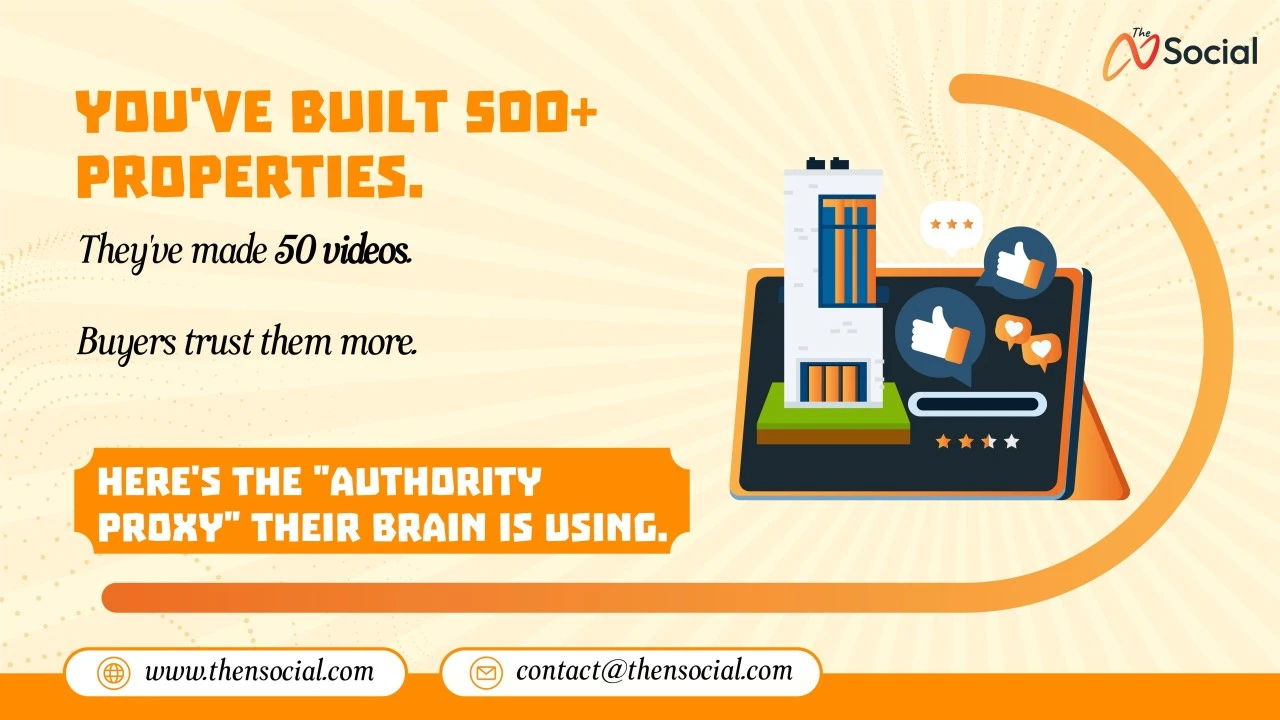
- 500+ projects mean nothing if buyers can't find/verify/understand your credibility
Modern real estate isn't about construction skills alone. It's about translating those skills into authority signals buyers can evaluate before the first site visit.
Ready to Reclaim Authority From 25-Year-Old YouTubers?
If you're losing buyers to influencers with 1% of your experience, stop treating digital presence as beneath you.
Start treating it as a competitive necessity.
- ✅ Educational visibility strategy (construction quality content, not property ads)
- ✅ Communication authority systems (response velocity = competence signal)
- ✅ Transparency architecture (virtual access to quality proof/compliance documentation)
- ✅ Authority positioning frameworks (industry leadership demonstration)
- ✅ Experience translation (converting decades of expertise into recognizable trust signals)
The NSocial specializes in psychology-driven real estate authority building:
- 🎯 Builder's Digital Authority Roadmap (30-year experience → visible credibility in 90 days)
- 🎯 Authority Proxy Audit (Why YouTubers are trusted more than you)
- 🎯 Transparency Strategy Framework (What to share for maximum trust, minimum risk)
- 🎯 Developer Positioning System (From invisible expert to recognized authority)
Stop losing to YouTubers. Start leveraging psychology:
- ✅ Authority Proxy Framework (How buyers actually evaluate you)
- ✅ Visibility-to-Trust Blueprint (Strategic educational presence)
- ✅ Communication Excellence System (Response = reliability signal)
- ✅ Transparency Architecture Guide (What to share for maximum credibility)
Stop being out-positioned by YouTubers. Start translating your experience into visible authority. You've built 500 properties. They can't verify that until they choose you. Give them authority signals they CAN verify before they decide.**