The Last-Minute Deal Loss Nobody Talks About
Here's the uncomfortable truth about high-ticket sales:
Most deals don't fail during pitches or pricing discussions. They fail in the silent 7-second Google evaluation the neurological vetting process that happens after verbal agreement but before payment.
You see it in the numbers:
- 67% of high-ticket buyers (₹5L+ decisions) Google the provider AFTER verbal commitment but before signing (B2B Purchase Psychology Study, 2024)
- 43% of these buyers change their mind based on what they find in first page of search results (Google Consumer Trust Research)
- Average decision-maker spends 4-7 seconds scanning Google results before deciding to proceed or investigate competitors (Search Behavior Analysis, 2024)
- 82% of premium buyers say "online presence quality" is as important as "in-person professionalism" in final decision (Luxury Services Purchase Report)
- Losing one ₹10L deal due to poor digital presence costs more than 6 months of professional branding investment (Client Acquisition Cost Analysis)
The data is clear: Your digital footprint isn't marketing. It's the final vetting process before every major sale.
But here's what traditional sales training ignores: The neurological trust assessment happening in those 7 seconds and what triggers the "investigate alternatives" response.
Where Deals Actually Break (And The Search Psychology You're Missing)
Last-minute deal losses don't happen randomly. They happen when Google reveals a trust signal mismatch between what you promised in-person and what your digital presence confirms.
The providers closing 70-85% of verbal commitments aren't better at sales; they're engineering digital first impressions that pass the neurological credibility test.
Let's break down the three critical search moments and the psychology-backed solutions:
1. The First-Page Trust Scan: Where 7 Seconds Determines ₹10L Decisions
The Problem: Your in-person pitch passed the credibility test, but your Google results fail the authority confirmation scan.
The Data:
- 92% of high-ticket buyers never go past first page of Google results when vetting providers (Search Engine Trust Study)
- The brain makes "credible vs. questionable" judgment in 7 seconds of scanning search results (Visual Processing Research, MIT)
- Prospects seeing inconsistent messaging across top 5 results are 73% more likely to comparison-shop (Purchase Decision Abandonment Study, 2024)
- LinkedIn profile appearing before personal website reduces perceived authority by 34% among C-suite buyers (Executive Purchase Psychology)
- Providers with optimized Google Knowledge Panels close deals 28% faster than those without (B2B Sales Velocity Research, 2024)
What's Actually Breaking:
- No strategic control over what appears in top 5 search results
- Outdated profiles contradicting current positioning
- Missing visual consistency that confirms professionalism
- Low-quality content ranking higher than authority pieces
- Generic LinkedIn/social profiles instead of credibility-rich presences
What High-Closing Professionals Do Differently:
LElite jewelry brands use heritage trust layering that:
- ✅ Document creation process showing artisan expertise, time, precision (builds "labor of love" perception)
- ✅ Educate on material sourcing (ethical mining, gem certification, metal purity) = transparency trust
- ✅ Showcase quality markers invisible in photos (hand-setting techniques, microscopic details, durability testing)
- ✅ Position pieces as heirlooms, not accessories (emotional value + investment framing)
Real-World Application:
Elite service providers use search result architecture that:
- ✅ Control first page narrative through SEO-optimized owned properties (personal sites, featured articles)
- ✅ Create visual consistency across all top results (same headshot, color scheme, messaging)
- ✅ Optimize for "credibility keywords" buyers actually search (your name + credentials, outcomes, methodology)
- ✅ Deploy strategic content that ranks above noise (published articles, case studies, media features)
Low-trust Google result pattern:
- Outdated LinkedIn (last post 8 months ago)
- Generic company page (looks like template)
- Social media with personal content mixed with professional
- Third-party directory listing (makes you look commodity)
- Random blog comment from 2019
Prospect's brain: "They said they're an expert, but Google shows someone who's... inconsistent? Checking competitors."
High-trust Google result pattern:
- Professional personal website (clear positioning, outcomes, testimonials)
- Recent authoritative article on industry site
- Polished LinkedIn with active thought leadership
- Google Knowledge Panel (name, credentials, publications)
- Media feature or podcast interview
Prospect's brain: "Everything checks out. This person is exactly who they presented as. Moving forward."
Psychology-first agencies like The Nsocial engineer these patterns by conducting digital first impression audits seeing exactly what prospects see and strategically optimizing for trust confirmation.
The Insight: Your Google results aren't about discoverability. They're about credibility confirmation in the final decision moment.
2. The Credibility Consistency Check: Why Mixed Messaging Kills ₹20L Deals
The Problem: Your pitch positioned you as a premium expert, but your online presence shows inconsistent authority signals triggering buyer skepticism.
The Data:
- 78% of premium buyers compare in-person claims against online evidence before finalizing (Trust Verification Behavior Study)
- Messaging inconsistency across platforms increases deal abandonment by 41% (Brand Consistency Impact Research, 2024)
- High-ticket buyers visit average of 6.3 digital touchpoints during vetting process (B2B Customer Journey Analysis)
- 68% of lost deals cite "couldn't verify expertise claims online" as contributing factor (Deal Loss Attribution Study)
- Prospects finding contradictory information (old vs. new positioning) are 5.2x more likely to ghost (Purchase Psychology Research, 2024)
What's Actually Breaking:
- Old social media posts contradicting current expertise claims
- Multiple outdated "About" sections with different stories
- Testimonials don't match specific outcomes you now promise
- Visual branding inconsistency makes you look unprofessional
- Can't find proof of claims you made during sales conversation
What Trusted Experts Track:
Top 20% of high-ticket closers don't just track pipelines they track digital credibility coherence.
Agencies like The NSocial provide:
- ✅ Cross-platform messaging audits: Does every touchpoint tell the same authority story?
- ✅ Claim verification mapping: Can prospects find evidence for every expertise claim you make?
- ✅ Timeline consistency analysis: Does your evolution make sense or look suspicious?
- ✅ Visual trust scoring: Do your photos/graphics signal premium positioning consistently?
Real-World Application:
Deal-killing inconsistency pattern:
- LinkedIn says: "Marketing Consultant | 5 Years Experience"
- Website says: "Award-Winning Marketing Surgeon | 10 Years"
- Old blog post: "Starting my marketing journey..."
- Instagram bio: Different tagline entirely
Prospect thinks: "Which version is true? Are they exaggerating? Too risky for ₹15L investment."
Deal-closing consistency pattern:
- LinkedIn headline: "₹4.2 Cr Generated for 23 B2B Brands | Marketing Surgeon | Neuro-Performance Strategy"
- Website homepage: Same tagline, expanded proof
- Recent articles: All reinforce "marketing surgeon" positioning
- Google images: Same professional photos across platforms
- Testimonials: Specific outcomes matching current claims
Prospect thinks: "Everything aligns. They're exactly who they say. Let's sign."Prospect thinks: "Everything aligns. They're exactly who they say. Let's sign."
When high-ticket service providers work with psychology-first agencies, they discover:
- Every digital touchpoint is being evaluated during deal consideration
- Inconsistency triggers "something's off" gut response (even if prospects can't articulate why)
- Authority isn't just claimed it must be confirmed across multiple independent sources
- Visual and verbal consistency creates subliminal credibility boost
The Insight: Prospects don't need to find everything about you. But everything they find must confirm what you told them.
3. The Comparison Shopping Trigger: Why "Good Enough" Digital Presence Loses to Inferior Competitors
The Problem: You're more qualified, but a competitor's digital presence triggers higher perceived authority and prospects choose polish over expertise.
The Data:
- In final decision stage, 71% of buyers weight "how professional they look online" equally with "actual qualifications" (Purchase Decision Factors Study, 2024)
- Competitors with inferior expertise but superior digital presence win 43% of comparison scenarios (B2B Competitive Analysis)
- Premium buyers view 3.7 competitor websites during final vetting before decision (Search Behavior in High-Ticket Purchases)
- 89% of deal losses to "less qualified" competitors involve superior competitor SEO/content presence (Lost Deal Analysis Report)
- First-impression digital polish creates "halo effect" - prospects assume better online presence = better service quality (Cognitive Bias in Buying)
What's Actually Breaking:
- Competitor's content outranks yours on key search terms
- Their website looks more premium despite your superior results
- They have social proof strategically placed; yours is buried/absent
- Their thought leadership is more visible and recent
- Prospects see them more often in their feed = availability bias kicks in
What Market Leaders Do:
Elite providers don't just be better they architect the perception of being better through strategic digital positioning.
Psychology-backed reputation systems (like those engineered by The Nsocial) include:
- ✅ Competitive search presence audits: What do prospects see when comparing you vs. competitors?
- ✅ Authority signal engineering: Strategic placement of credentials, media, testimonials
- ✅ Thought leadership velocity: Consistent visibility that triggers "top of mind" bias
- ✅ Premium perception design: Visual and content quality that signals high-ticket positioning
- ✅ Social proof architecture: Third-party validation placed in high-impact discovery moments
Real-World Application:
How deals get lost to less-qualified competitors:
Your Google presence:
- Basic website (template design, minimal content)
- LinkedIn with sporadic posts
- Few testimonials, no case studies visible
- No recent media mentions or published articles
Competitor's Google presence:
- Premium website (professional design, clear value proposition)
- Active thought leadership (weekly insights)
- Featured testimonials on homepage
- Recent podcast interview, published article in industry publication
- Google Knowledge Panel showing credentials
Prospect's comparison thought process: "Both seem qualified. But this one [competitor] looks more established. Safer choice. I'll go with them."
The qualified provider just lost a ₹25L deal not because they're worse, but because their digital presence failed the credibility comparison test.
When working with The Nsocial, providers receive:
- Competitive positioning analysis: Where you rank vs. competitors in perception
- Authority gap identification: What credibility signals you're missing that competitors have
- Strategic digital presence roadmap: How to outposition competitors systematically
- Perception engineering frameworks: Creating premium positioning that justifies premium pricing
The Insight: In the final comparison moment, perception beats reality. Control the perception or lose to prettier packaging.
Why "Just Be Good at Your Job" Advice Loses Deals (And What Actually Works)
The Traditional Approach:
- Focus on service delivery excellence
- Let results speak for themselves
- Assume good work leads to referrals
- Treat online presence as secondary to in-person relationships
The Problem: By the time prospects Google you after verbal commitment, your lack of strategic digital presence has already planted doubt seeds. Excellence doesn't matter if trust isn't confirmed online.
The New Standard: Digital Trust Architecture Systems
Instead of hoping prospects "see past" weak online presence, engineer confirmation:
First-page narrative control: Own top 5 Google results with strategic content
- ✅ Cross-platform coherence: Every touchpoint reinforces same authority story
- ✅ Credibility signal density: Layered proof at every discovery point
- ✅ Competitive positioning: Outrank competitors on key vetting searches
- ✅ Premium perception design: Visual and content quality matching price point
This is where psychology-first reputation engineering changes the game.
Agencies like The Nsocial who specialize in neuro-performance marketing give high-ticket providers:
Digital First Impression Audits:
- "Prospects Googling your name see contradictory positioning across 3 platforms"
- "Your competitor outranks you on '[your name] + reviews' search"
- "Zero credibility signals appear in critical first 7-second scan window"
Search Psychology Optimization:
- SEO for trust confirmation (not just traffic)
- Visual credibility design (premium perception engineering)
- Authority content placement (strategic thought leadership)
- Social proof architecture (testimonials in high-impact locations)
Competitive Positioning Strategy:
- Where you rank vs. competitors in buyer perception
- What authority signals you're missing that competitors leverage
- How to systematically win comparison scenarios
The result? Providers increase deal close rate from 60-70% to 80-92% not by being better, but by digitally confirming they're better.
Stop Losing Deals in the Final Google Search
Most qualified providers don't lose deals from lack of expertise. They lose deals because digital presence fails to confirm what in-person pitch promised.
Here's what the data proves:
- 67% of verbal commitments go through final Google vetting before payment
- 7-second credibility scan determines if prospect proceeds or investigates alternatives
- 43% of deal losses involve "more qualified provider lost to better online presence"
- Strategic first-page control increases close rate by 22-32%
Deal closing isn't just about sales skills. It's about controlling the silent evaluation happening in those final 7 seconds.
Stop Losing ₹10-20L Deals in the Final Google Search
You closed them in the meeting. They shook hands. They said "let's do this."
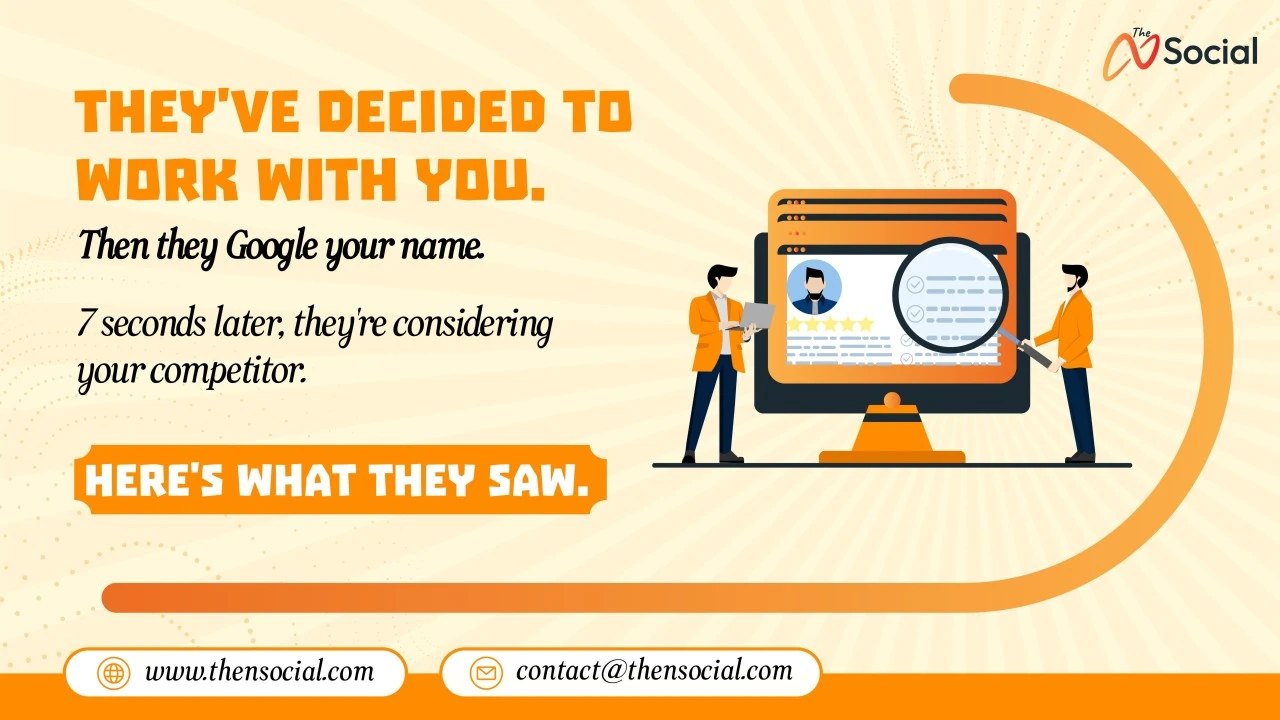
Then they Googled you.
7 seconds later, they're ghosting your follow-ups and signing with your competitor.
You don't have a sales problem. You have a digital credibility confirmation problem.
Here's What's Killing Your Deals:
- ❌ First-page Google shows outdated/inconsistent profiles → "Are they even active?"
- ❌ No credibility signals in those critical 7 seconds → "I can't verify their claims"
- ❌ Competitor's digital presence looks more premium → "Safer to go with them"
- ❌ Missing social proof at vetting stage → "I don't see proof they've done this before"
- ❌ Zero response when prospects search "[Your Name] + reviews/results" → "That's suspicious"
The Nsocial finds the exact digital gaps losing your deals and fixes them before your next pitch.
See What Your Prospects See (Before They Choose Someone Else)
Free Digital First Impression Audit:
We'll Google you the way your prospects do and show you:
- ✅ What appears in those critical 7 seconds (and what's triggering doubt)
- ✅ The exact credibility gaps killing deals after verbal commitment
- ✅ How you compare vs. competitors in final vetting searches
- ✅ Which authority signals you're missing (that competitors have)
- ✅ Your biggest deal-killer (the #1 thing costing you closes)
No generic report. We actually Google you, screenshot the results, and show you why prospects are backing out.