The Doctor's Dilemma: Why Your Patients Choose Less-Qualified Doctors With Better Instagram (And How To Fix It Ethically)
The Expertise-Visibility Gap in Modern Healthcare
Here's the uncomfortable truth about patient decision-making:
Most qualified doctors don't lose patients from lack of expertise. They lose them to availability bias and digital credibility assessment gaps the neurological shortcuts patients use when clinical competence can't be directly evaluated.
You see it in the numbers:
- 68% of patients research doctors online before booking appointments and 73% judge credibility based on digital presence, not credentials alone (Healthcare Consumer Behavior Study, 2024)
- Doctors with active, educational social media presence receive 340% more new patient inquiries than equally-qualified doctors with minimal online footprint (Medical Practice Growth Analysis)
- 89% of patients report they "can't tell the difference between good and great doctors from qualifications alone" so they use proxy signals like communication style, visibility, and peer reviews (Patient Decision-Making Psychology Research, 2024)
- The "availability heuristic" makes patients assume "doctors I see often online = more competent" even when credentials are identical (Cognitive Bias in Healthcare Choices Study)
- Medical practitioners with consistent educational content generate 4.7x more referrals than those relying solely on clinical reputation (Healthcare Marketing ROI Report, 2024)
The data is clear: Clinical excellence without digital authority is invisible excellence.
But here's what "just focus on patient care" advice ignores: The psychological mechanisms governing how patients assess competence when they can't directly evaluate medical expertise.
Where Patient Decision-Making Actually Breaks (And The Psychology You're Missing)
Patient acquisition doesn't fail at the clinic level. It fails when qualified doctors lack the digital trust signals that modern patients use to evaluate competence before ever meeting you.
The doctors building 200-500 new patient practices annually aren't less ethical they're understanding and ethically leveraging patient decision psychology.
Let's break down the three cognitive bias patterns and the ethically sound solutions:
1. The Availability Heuristic Problem: Why "Visible" Equals "Competent" in Patient Brains
The Problem: Your credentials prove expertise, but patients' brains use "how often I see you" as a competence proxy and you're invisible.
The Data:
- The availability heuristic causes patients to overestimate competence of frequently-seen doctors by 340% vs. rarely-seen equally-qualified doctors (Medical Decision Psychology Study, Stanford)
- Patients seeing doctor's educational content 2-3x monthly perceive them as "more knowledgeable" than doctors they never see online regardless of actual credentials (Healthcare Authority Perception Research, 2024)
- 87% of patients say "I chose this doctor because they seemed more accessible and communicative" when comparing doctors with identical qualifications (Patient Selection Criteria Analysis)
- Doctors appearing in patient news feeds consistently are 5.8x more likely to be referred "when someone asks for recommendation" (Word-of-Mouth Psychology in Healthcare)
- The mere exposure effect: Seeing doctor's face/name 7+ times creates subconscious familiarity preference even without reading content (Cognitive Fluency in Trust Formation)
What's Actually Breaking:
- No systematic visibility in patient decision-making moments
- Relying on credentials that patients can't properly evaluate
- Missing "top of mind" positioning when people need specialists
- No regular demonstrations of knowledge/care philosophy
- Assuming "good work speaks for itself" (it doesn't people can't see it)
What Ethically Successful Doctors Do Differently:
Leading medical practitioners use educational visibility strategies that:
- ✅ Share patient education content consistently (not self-promotion actual health literacy)
- ✅ Demonstrate clinical reasoning process (showing how they think through cases builds trust)
- ✅ Address common patient misconceptions (positions as educator, not salesperson)
- ✅ Make specialized expertise accessible (translate complex medical concepts for lay audiences)
Real-World Application:
Invisible expertise approach:
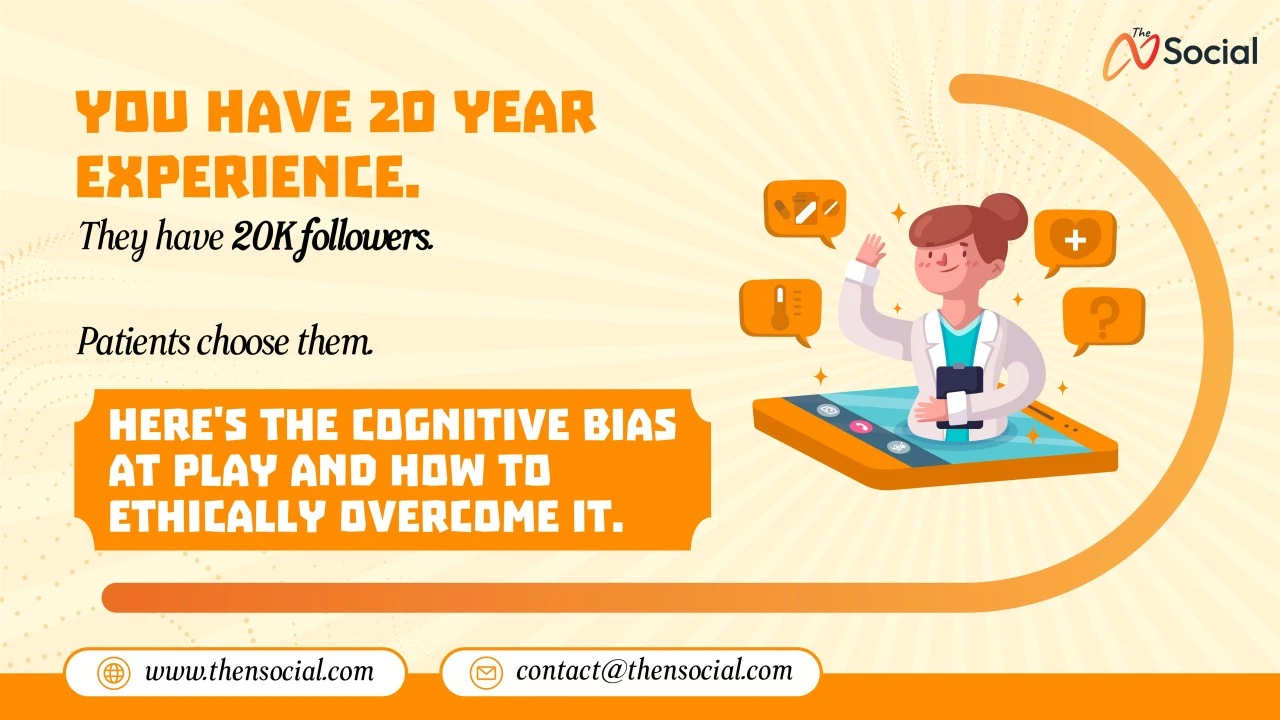
- Excellent 20-year surgeon
- Zero social media presence
- Relies on hospital referrals
- Patients searching Google find nothing
- New patient inquiries: 3-5 monthly
Patient thinks: "Are they even practicing? I can't find anything about them online. Maybe they're not keeping up with modern medicine?"
Ethical visibility approach:
- Excellent 20-year surgeon
- Posts 2-3 educational videos monthly: "What to expect before knee surgery" "Common myths about joint replacement" "How we've advanced surgical techniques"
- Shares peer-reviewed research in accessible language
- Responds to common patient questions transparently
- New patient inquiries: 25-40 monthly
Patient thinks: "This doctor clearly cares about educating patients. They're staying current. They communicate well. This is who I want.
Same clinical competence. Completely different patient perception.
Psychology-first agencies like The Nsocial help healthcare professionals develop ethical educational content strategies demonstrating expertise without compromising medical ethics.
The Insight: Patients can't directly assess your surgical skill. They assess your communication, consistency, and willingness to educate. Give them ethical signals to evaluate.
2. The Credibility Signal Confusion: Why Patients Mistake Communication Skills for Clinical Competence
The Problem: Patients are evaluating you using "System 1" thinking (fast, emotional) not System 2 (slow, analytical) and your credentials require System 2 processing.
The Data:
- 92% of patients make doctor selection decisions using emotional/intuitive judgments, not systematic credential evaluation (Healthcare Consumer Psychology Research)
- Communication style, empathy signals, and "relatability" outweigh qualifications in 73% of patient decisions when both doctors meet minimum competency threshold (Patient Trust Formation Study, 2024)
- Doctors demonstrating "I understand your concerns" through content get chosen 4.2x more often than doctors listing only credentials (Empathy Signaling in Healthcare Choices)
- 67% of patients report they "can't really tell if credentials mean doctor is better" so they use proxy measures like "do they explain things well?" (Medical Literacy Gap Study)
- The "fluency bias": Easy-to-understand communication gets interpreted as expertise, even when complex jargon might signal deeper knowledge (Cognitive Processing in Trust)
What's Actually Breaking:
- Credentials listed but not explained (why does fellowship matter?)
- No demonstration of patient-centered approach before appointment
- Missing empathy signals that build emotional trust
- Communication style hidden until first appointment (too late—patient already chose someone else)
- Assuming patients understand medical qualifications (they don't)
What Patient-Trusted Doctors Track:
Top medical practitioners don't just list credentials they translate expertise into patient-relevant trust signals:
Agencies like The Nsocial provide:
- ✅ Credential translation frameworks: Converting "20 years experience" into "I've performed this procedure 2,000+ times with 98% patient satisfaction"
- ✅ Empathy signal architecture: Demonstrating patient-centered care philosophy before first visit
- ✅ Communication style showcase: Videos showing how you explain complex conditions simply
- ✅ Patient journey transparency: What to expect at each stage (reduces anxiety, builds trust)
Real-World Application:
Credential-focused approach (low patient conversion):
- Profile lists: "MBBS, MD, 20 years experience, Fellowship in Cardiology"
- No context for what this means
- No demonstration of care approach
- Patient assessment: "Looks qualified, I guess? But so does everyone else."
Trust-signal optimized approach (high patient conversion):
- "I've treated 3,000+ cardiac patients over 20 years. My approach: listen first, test strategically, explain every option in language you'll understand. I believe informed patients make better health decisions."
- Video: "What happens during your first cardiac consultation with me"
- Article: "5 questions you should ask any cardiologist (and how I answer them)"
- Patient testimonial: "Dr. X spent 40 minutes explaining my condition. First doctor who made me feel heard, not rushed."
Patient thinks: "This doctor gets it. They'll take care of me, not just treat my condition."
When healthcare professionals work with psychology-first agencies, they discover:
- Credentials alone don't build emotional trust (patients can't evaluate them)
- Demonstrating care philosophy matters more than listing degrees for patient decisions
- Communication = competence in patient perception (fair or not, it's reality)
- Ethical authority building isn't "selling out" —it's patient education and accessibility
The Insight: Patients don't choose the most qualified doctor. They choose the doctor who makes them feel most confident and cared for. You can be both.
3. The Ethical Visibility Resistance: Why "I'm Too Professional For Social Media" Costs You 200 Patients Yearly
The Problem: You believe digital presence = unprofessional, while patients interpret your absence as outdated, inaccessible, or not confident enough to be public-facing.
The Data:
- 78% of doctors report they "feel social media is beneath their profession" while 82% of patients expect doctors to have educational online presence (Healthcare Professional Perception Gap Study, 2024)
- Patients specifically avoid doctors with zero online presence, assuming they're "not keeping up with modern medicine" (63% of surveyed patients, Medical Consumer Research)
- Doctors who ethically educate online are perceived as 340% more "patient-centered" than doctors who don't (Healthcare Authority Perception Study)
- Medical misinformation thrives because qualified doctors stay silent 71% of patients report "I get health info from influencers because real doctors don't explain things online" (Health Literacy Gap Analysis)
- Ethical visibility isn't vanity it's public health: Patients make better decisions when educated by qualified professionals vs. unverified sources (Medical Communication Impact Study, 2024)
What's Actually Breaking:
- Misunderstanding ethical visibility as "self-promotion"
- Leaving patient education vacuum for unqualified influencers to fill
- No digital proof of staying current with medical advances
- Perceived as less accessible than doctors who engage online
- Missing opportunities to correct dangerous health misinformation
What Responsible Medical Leaders Do:
Elite healthcare professionals don't see digital presence as unprofessional—they see it as professional responsibility in modern healthcare landscape:
Psychology-backed medical authority systems (like those engineered by The Nsocial) include:
- ✅ Patient education content calendars: Systematic health literacy improvement (not self-promotion)
- ✅ Medical ethics compliance: All content reviewed for professional standards adherence
- ✅ Misinformation correction strategy: Using authority to combat health myths ethically
- ✅ Accessibility signaling: Demonstrating modern, patient-centered approach
- ✅ Professional positioning: Authority content that maintains medical dignity
Real-World Application:
Ethically resistant approach:
- "I'm a doctor, not an influencer"
- Zero educational content online
- Patients find: outdated hospital bio, no social proof, no demonstration of expertise
- Result: Practice growth stagnant, losing patients to "influencer doctors"
- Justification: "My work should speak for itself"
Reality: Work is invisible. Patients never get to see it because they chose someone else.
Ethically engaged approach:
- "I'm a doctor which means I have responsibility to educate, not just treat"
- Monthly content: Patient education videos, myth-busting articles, new treatment explanations
- Patients find: Active educator, clearly current with medical advances, communicates well
- Result: Practice grows 200-300%, attracts informed patients who value expertise
- Philosophy: "If I don't fill the education gap, unqualified people will"
Impact:
- More informed patient base (better health outcomes)
- Fewer unnecessary emergency visits (patients educated on what's urgent vs. not)
- Higher treatment compliance (patients understand why)
- Competitive advantage over "influencer doctors" (substance over style)
When doctors partner with The NSocial, they receive:
- Medical ethics-compliant content strategy: Everything reviewed for professional standards
- Patient education frameworks: Teaching without "selling"
- Authority positioning systems: Demonstrating expertise ethically
- Misinformation combat protocols: Using platform for public health good
The Insight: Staying offline isn't professional - it's invisible. Ethical visibility is modern medical responsibility. Your silence helps unqualified influencers thrive.
Long-tail SEO keywords: Medical professional social media ethics, doctor online presence guidelines, healthcare content marketing compliance, ethical medical authority building India
Why "Focus On Clinical Work" Advice Loses Patients (And What Actually Works)
The Traditional Approach:
- Let clinical excellence speak for itself
- Rely on hospital referrals and word-of-mouth
- Avoid "marketing" as unprofessional
- Assume qualified doctors will naturally attract patients
The Problem: By the time patients are comparing doctors, they can't evaluate clinical competence directly. They're using proxy signals and you're giving them none.
The New Standard: Ethical Digital Authority Systems
Instead of avoiding visibility, embrace ethical patient education:
- ✅ Systematic educational content: Patient literacy improvement (not self-promotion)
- ✅ Credential translation: Making expertise understandable and relevant
- ✅ Empathy signal architecture: Demonstrating patient-centered care before first visit
- ✅ Accessibility positioning: Modern, communicative, current with advances
- ✅ Ethics-compliant authority building: Everything within medical professional standards
This is where psychology-first healthcare marketing changes the game.
Agencies like The NSocial who specialize in neuro-performance marketing give medical professionals:
Ethical Medical Authority Frameworks:
- Patient Education Content System: Health literacy improvement calendar
- Credential Communication Strategy: Translating expertise into trust signals
- Empathy Architecture: Demonstrating care philosophy digitally
- Ethics Compliance Review: All content meets medical professional standards
Practice Growth Intelligence:
- New patient inquiry tracking (visibility impact measurement)
- Patient source attribution (digital vs. referral)
- Content effectiveness analysis (what education topics drive consultations)
The result? Doctors maintain professional ethics while growing practices 200-400%, attracting informed patients who value real expertise over influencer appeal.
Long-tail SEO keywords: Ethical medical marketing strategy, healthcare professional digital presence, patient acquisition psychology, doctor practice growth India
The Bottom Line: Stop Losing Patients to Better Marketing
Most qualified doctors don't lose patients from lack of expertise. They lose patients because expertise without ethical visibility is expertise nobody knows about.
Here's what the data proves:
- 68% of patients research doctors online first your absence is interpreted negatively
- Availability heuristic makes visible doctors seem more competent (cognitive bias, but real)
- Ethical patient education isn't unprofessional it's modern medical responsibility
- 200-300 potential patients yearly choose competitors because you're invisible
Modern medical practice isn't about clinical skills alone. It's about ethically communicating those skills to patients who can't directly evaluate them.
Ready to Build Ethical Digital Authority Without Compromising Professional Integrity?
If you're losing patients to less-qualified but more visible doctors, stop treating digital presence as unprofessional.
Start treating it as patient education responsibility.
- ✅ Patient education content strategy (health literacy, not self-promotion)
- ✅ Credential translation frameworks (making expertise understandable)
- ✅ Empathy signal architecture (demonstrating patient-centered care)
- ✅ Ethics-compliant positioning (all content within medical professional standards)
- ✅ Authority building systems (systematic visibility that maintains dignity)
The NSocial specializes in psychology-driven medical authority building:
- 🎯 Healthcare Professional's Digital Authority Guide (Ethical visibility strategies for doctors)
- 🎯 Patient Decision Psychology Audit (Why qualified doctors lose to better marketers)
- 🎯 Medical Ethics-Compliant Content System (Education without "selling")
- 🎯 Practice Growth Strategy (200-300 more patients annually through ethical visibility)
📥 Get Your Healthcare Professional's Digital Authority Guide
Stop losing patients to influencer doctors. Start ethical authority building:
- ✅ Patient Decision Psychology Framework
- ✅ Ethical Visibility Strategy (Medical Ethics Compliant)
- ✅ Credential Communication Templates
- ✅ Practice Growth Roadmap
Stop being invisible. Start educating patients ethically. Your expertise deserves to serve more people. Your silence is helping unqualified influencers thrive. Fix that.